
 Tiếng Việt
 简体中文
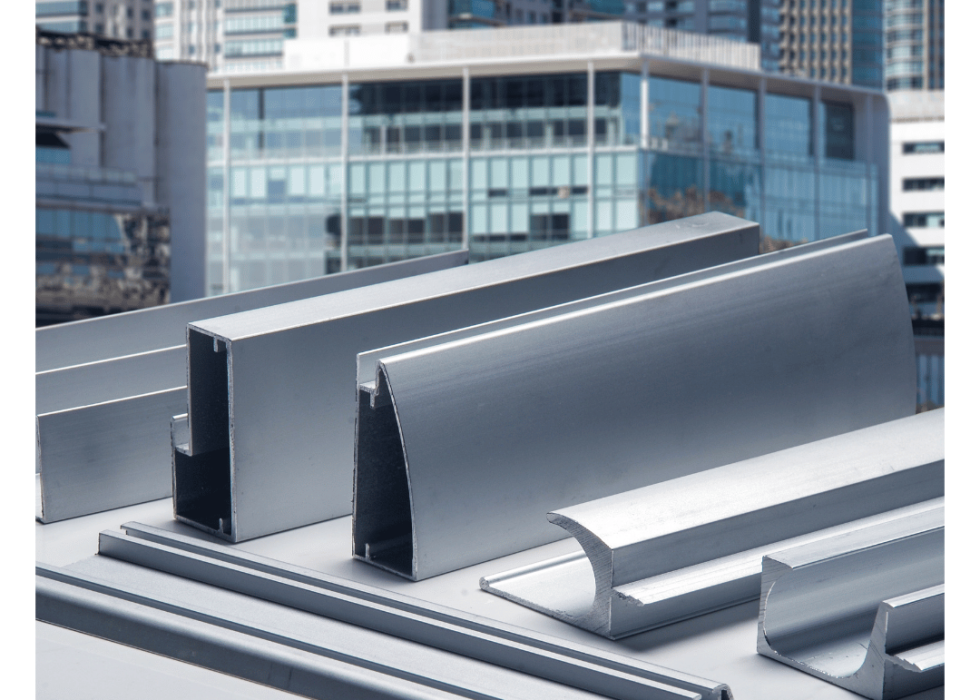
Procedures for importing shaped aluminum bars
Shaped aluminium bars (aluminium profiles) are used for doors, windows, facades and industrial frames. They are subject to quality inspection by the construction authority and, when made in China, to anti-dumping duty. Here is what you need to know.
1. Import policy
Legal basis: Decree 69/2018/ND-CP, Circular 38/2015/TT-BTC (amended by 39/2018/TT-BTC), Circular 19/2019/TT-BXD, Decision 2942/QD-BCT dated 28/09/2019 on anti-dumping duty, and Decree 128/2020/ND-CP. Aluminium profiles are not banned from import, but:
- They must pass import quality inspection under Circular 19/2019/TT-BXD;
- They are subject to anti-dumping duty under Decision 2942/QD-BCT (rate depends on the manufacturer – check the current rate before ordering);
- Goods must be labelled under Decree 43/2017/ND-CP;
- Classify the right HS code to pay the right tax and avoid penalties.
2. Labelling
Imported goods must be labelled under Decree 43/2017/ND-CP (amended by Decree 111/2021/ND-CP): exporter, importer, product name and information, and origin, placed where it is easy to see (cartons, crates, packaging). Missing or wrong labels can be fined under Decree 128/2020/ND-CP and may cause the C/O to be rejected.
3. HS codes
| HS code | Description | Normal duty (%) | MFN preferential (%) | VAT (%) | ACFTA (%) |
|---|---|---|---|---|---|
| 7604 | Aluminium bars, rods and profiles | ||||
| 760410 – Of aluminium, not alloyed: | |||||
| 76041010 | – – Bars and rods | 7.5 | 5 | 8 | 0 |
| 76041090 | – – Other | 15 | 10 | 8 | 0 |
| – Of aluminium alloys – 760421 Hollow profiles: | |||||
| 76042110 | – – – Of a kind suitable for air-conditioner evaporators of motor vehicles | 15 | 10 | 8 | 0 |
| 76042120 | – – – Aluminium spacers for doors and windows | 15 | 10 | 8 | 0 |
| 76042190 | – – – Other | 15 | 10 | 8 | 0 |
| 760429 – Other: | |||||
| 76042910 | – – – Extruded bars and rods | 7.5 | 5 | 8 | 0 |
| 76042930 | – – – Y-shaped profiles for zip fasteners, in coils | 15 | 10 | 8 | 0 (-KH) |
| 76042990 | – – – Other | 15 | 10 | 8 | 0 (-KH) |
MFN import duty is 5–10%, import VAT 8% or 10%, plus anti-dumping duty for Chinese-origin goods. A valid C/O is needed for the special preferential rate.
4. Import duty and VAT
Import duty = CIF value × duty rate. VAT = (CIF value + import duty) × VAT rate. With a valid certificate of origin (Form E from China, Form D from ASEAN, and other FTAs) the special preferential rate – usually 0% – applies.
5. Import dossier
- Customs declaration
- Sales contract
- Commercial invoice
- Packing list
- Bill of lading
- Certificate of origin (if any) – needed for special preferential duty, often 0%
- Catalogue (if any) and other documents on customs request
- Quality inspection registration confirmed by the Department of Construction
6. Quality inspection
- Register: file the original registration at the Department of Construction where your company is registered; you receive a confirmed copy.
- Release: submit the confirmed registration with the customs dossier; customs releases the goods to your warehouse.
- Sampling and testing: the testing centre takes samples (usually at your warehouse) and issues a conformity certificate.
- Clearance: submit the certificate to clear the declaration. Goods that fail must be re-exported.
7. Import procedure
- Declare: once contract, invoice, packing list, B/L, C/O and arrival notice are ready and the HS code is confirmed, submit the e-declaration (within 30 days of arrival).
- Open the declaration: the system assigns green, yellow or red channel; bring the dossier to the customs branch within 15 days. The confirmed quality inspection registration must be in the dossier before the goods can be released.
- Clearance: after document (and physical) checks, pay import duty and VAT; the declaration is cleared.
- Delivery: settle port charges, collect the delivery order and truck the goods to your warehouse.
8. ANLITA notes
- Goods may only be sold after the declaration is cleared;
- Check the anti-dumping rate of your manufacturer before signing the contract;
- The C/O is key to the special preferential rate;
- Prepare original documents early to avoid demurrage and storage charges.
Need an HS code check, a duty estimate or a door-to-door quote? Contact ANLITA via Zalo, WeChat, WhatsApp or email – our team in Vietnam and China will reply quickly.
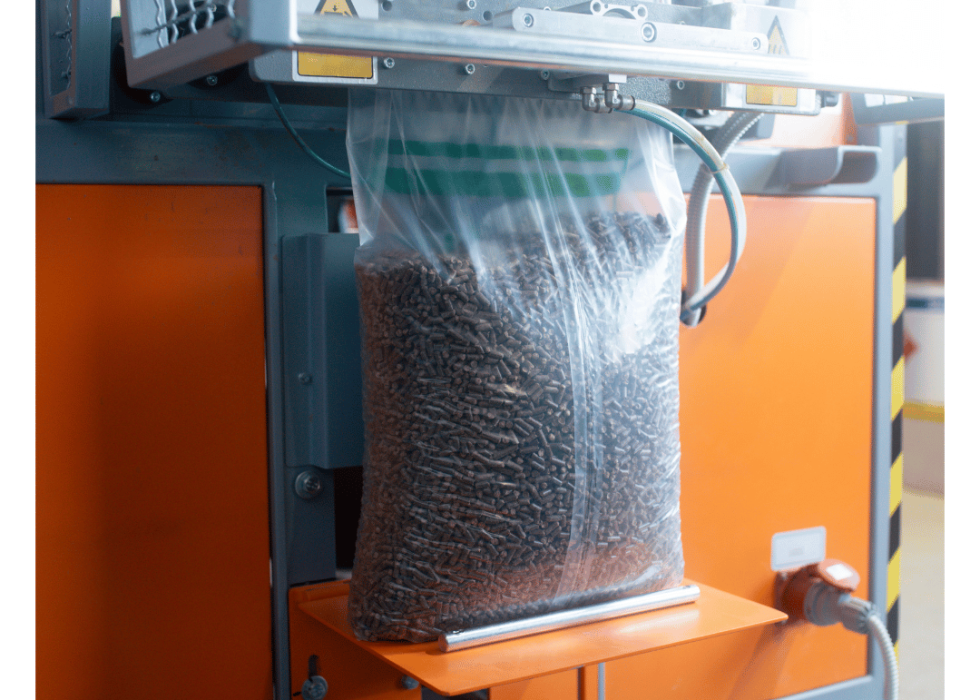
Procedures for importing wood pellet pressing machines
Wood pellet pressing machines turn sawdust and wood chips into fuel pellets. This article covers the import policy, HS code, taxes, documents and procedure for importing them into Vietnam.
1. Import policy
Legal basis: Circular 38/2015/TT-BTC (amended by 39/2018/TT-BTC), Decree 69/2018/ND-CP, Circular 09/2019/TT-BKHCN, Decree 43/2017/ND-CP and Decree 128/2020/ND-CP. Wood pellet presses are not banned from import. Please note:
- Used machines may be imported if they are not older than 10 years;
- Machines must be labelled under Decree 43/2017/ND-CP;
- Classify the right HS code to pay the right tax and avoid penalties.
2. Labelling
Imported goods must be labelled under Decree 43/2017/ND-CP (amended by Decree 111/2021/ND-CP): exporter, importer, product name and information, and origin, placed where it is easy to see (cartons, crates, packaging). Missing or wrong labels can be fined under Decree 128/2020/ND-CP and may cause the C/O to be rejected.
3. HS code
| HS code | Description | Normal duty (%) | MFN preferential (%) | VAT (%) | ACFTA (%) |
|---|---|---|---|---|---|
| 84793000 | – Presses for the manufacture of particle board or fibre building board of wood or other ligneous materials and other machinery for treating wood or cork | 3 | 2 | 8 | 0 |
A wrong HS code can delay clearance and be fined under Decree 128/2020/ND-CP. Send us the catalogue and technical data so we can confirm the code.
4. Import duty and VAT
Import duty = CIF value × duty rate. VAT = (CIF value + import duty) × VAT rate. With a valid certificate of origin (Form E from China, Form D from ASEAN, and other FTAs) the special preferential rate – usually 0% – applies.
5. Import dossier
- Customs declaration
- Sales contract
- Commercial invoice
- Packing list
- Bill of lading
- Certificate of origin (if any) – needed for special preferential duty, often 0%
- Catalogue (if any) and other documents on customs request
6. Import procedure
- Declare: once contract, invoice, packing list, B/L, C/O and arrival notice are ready and the HS code is confirmed, submit the e-declaration (within 30 days of arrival).
- Open the declaration: the system assigns green, yellow or red channel; bring the dossier to the customs branch within 15 days.
- Clearance: after document (and physical) checks, pay import duty and VAT; the declaration is cleared.
- Delivery: settle port charges, collect the delivery order and truck the goods to your warehouse.
7. ANLITA notes
- Import VAT of wood pellet presses is 8%;
- Choose a reliable supplier and a suitable payment method;
- Used machines: check the year of manufacture (max. 10 years);
- Label the machine in line with Decree 43/2017/ND-CP.
Need an HS code check, a duty estimate or a door-to-door quote? Contact ANLITA via Zalo, WeChat, WhatsApp or email – our team in Vietnam and China will reply quickly.

Procedures for importing children’s toys
Children’s toys are managed by the Ministry of Science and Technology. Most toys must pass state quality inspection under QCVN 3:2019/BKHCN before they can be sold in Vietnam. Below are the policy, HS codes, taxes, quality inspection and import procedure.
1. Import policy
Legal basis: Circular 09/2019/TT-BKHCN issuing QCVN 3:2019/BKHCN on toy safety, Circular 38/2015/TT-BTC (amended by 39/2018/TT-BTC), Decree 43/2017/ND-CP on labelling and Decree 128/2020/ND-CP. Toys are not banned from import, but:
- Toys listed in Circular 09/2019/TT-BKHCN must be registered for state quality inspection and certified to QCVN 3:2019/BKHCN;
- Educational toys may also need a culture check;
- Every package must be labelled;
- Samples may apply for exemption from quality inspection.
2. Labelling
Imported goods must be labelled under Decree 43/2017/ND-CP (amended by Decree 111/2021/ND-CP): exporter, importer, product name and information, and origin, placed where it is easy to see (cartons, crates, packaging). Missing or wrong labels can be fined under Decree 128/2020/ND-CP and may cause the C/O to be rejected.
3. HS codes of toys
| HS code | Description | Normal duty (%) | MFN preferential (%) | VAT (%) | ACFTA (%) |
|---|---|---|---|---|---|
| 9503 | Tricycles, scooters, pedal cars and similar wheeled toys; dolls’ carriages; dolls; other toys; reduced-size (“scale”) models and similar recreational models; puzzles of all kinds | ||||
| 95030010 | – Tricycles, scooters, pedal cars and similar wheeled toys; dolls’ carriages | 15 | 10 | 5 | 0 (-TH) |
| – Dolls: | |||||
| 95030021 | – – Dolls, with or without clothing | 15 | 10 | 5 | 0 (-ID, TH) |
| – – Parts and accessories: | |||||
| 95030022 | – – – Garments and accessories; footwear and headgear | 15 | 10 | 5 | 0 (-TH) |
| 95030029 | – – – Other | 15 | 10 | 5 | 0 (-TH) |
| 95030030 | – Electric trains, including tracks, signals and other accessories | 15 | 10 | 5 | 0 (-TH) |
| 95030040 | – Reduced-size (“scale”) models and similar recreational models | 15 | 10 | 5 | 0 (-LA, TH) |
| 95030050 | – Other construction sets and constructional toys, of materials other than plastics | 30 | 20 | 5 | 0 (-LA, TH) |
| 95030060 | – Stuffed toys representing animals or non-human creatures | 30 | 20 | 5 | 0 (-LA, TH) |
| 95030070 | – Puzzles of all kinds | 15 | 10 | 5 | 0 (-TH) |
| 95030080 | – Hand-held interactive electronic educational devices primarily designed for children | 30 | 20 | 5 | 0 (-ID, LA, TH) |
| – Other: | |||||
| 95030091 | – – Number, alphabet or animal blocks; word games; printing sets; counting frames (abaci); toy sewing machines and typewriters | 30 | 20 | 5 | 0 (-ID, TH) |
| 95030092 | – – Skipping ropes | 30 | 20 | 5 | 0 (-TH) |
| 95030093 | – – Marbles | 30 | 20 | 5 | 0 (-TH) |
| 95030094 | – – Other toys, of rubber | 30 | 20 | 5 | 0 (-ID, LA, TH) |
| 95030099 | – – Other | 30 | 20 | 5 | 0 (-ID, LA, TH) |
Import duty for toys is fairly high, 10–20% at the MFN rate; import VAT is 5% (Article 8, VAT Law 13/2008/QH12) once quality inspection is completed.
4. Import duty and VAT
Import duty = CIF value × duty rate. VAT = (CIF value + import duty) × VAT rate. With a valid certificate of origin (Form E from China, Form D from ASEAN, and other FTAs) the special preferential rate – usually 0% – applies.
5. Import dossier
- Customs declaration
- Sales contract
- Commercial invoice
- Packing list
- Bill of lading
- Certificate of origin (if any) – needed for special preferential duty, often 0%
- Catalogue (if any) and other documents on customs request
- Conformity certificate / quality inspection dossier (depending on the toy)
6. Quality inspection
- Register online: create an account on the National Single Window and file the registration with the local Standards, Metrology and Quality authority, choosing a designated testing body.
- Sampling: once the file is accepted, clear customs and let the testing body take samples at the port or at your warehouse.
- Result: upload the conformity certificate to the Single Window to complete the dossier.
7. Import procedure
- Declare: once contract, invoice, packing list, B/L, C/O and arrival notice are ready and the HS code is confirmed, submit the e-declaration (within 30 days of arrival).
- Open the declaration: the system assigns green, yellow or red channel; bring the dossier to the customs branch within 15 days. Attach the quality inspection registration number.
- Clearance: after document (and physical) checks, pay import duty and VAT; the declaration is cleared.
- Delivery: settle port charges, collect the delivery order and truck the goods to your warehouse.
8. ANLITA notes
- Classify the HS code by the toy’s actual features;
- Ride-on toys: the saddle height decides whether quality inspection is required;
- Movement toys for kindergartens are not classified as educational toys;
- Import VAT of toys is 5%.
Need an HS code check, a duty estimate or a door-to-door quote? Contact ANLITA via Zalo, WeChat, WhatsApp or email – our team in Vietnam and China will reply quickly.

Procedure for importing asphalt
Asphalt (bitumen) is widely used to build and maintain roads and car parks. Vietnam imports it from China, Russia, Thailand, the USA, Saudi Arabia and India. This article sums up the import policy, HS code, taxes, documents and procedure for asphalt.
1. Import policy
Legal basis: Circular 38/2015/TT-BTC (amended by 39/2018/TT-BTC), Decree 69/2018/ND-CP, Decree 43/2017/ND-CP and Decree 128/2020/ND-CP. Asphalt is not on the list of goods banned from import. Please note:
- Used goods are banned from import;
- Goods must be labelled under Decree 43/2017/ND-CP;
- Classify the right HS code to pay the right tax and avoid penalties.
2. Labelling
Imported goods must be labelled under Decree 43/2017/ND-CP (amended by Decree 111/2021/ND-CP): exporter, importer, product name and information, and origin, placed where it is easy to see (cartons, crates, packaging). Missing or wrong labels can be fined under Decree 128/2020/ND-CP and may cause the C/O to be rejected.
3. HS code of asphalt
| HS code | Description | Normal duty (%) | MFN preferential (%) | VAT (%) | ACFTA (%) |
|---|---|---|---|---|---|
| 2714 | Bitumen and asphalt, natural; bituminous or oil shale and tar sands; asphaltites and asphaltic rocks | ||||
| 27141000 | – Bituminous or oil shale and tar sands | 5 | 0 | 10 | 0 |
| 27149000 | – Other | 5 | 0 | 10 | 0 |
A wrong HS code can delay clearance and be fined under Decree 128/2020/ND-CP (from VND 2,000,000 up to 3 times the tax shortfall). Contact us to confirm the exact code for your product.
4. Import duty and VAT
Import duty = CIF value × duty rate. VAT = (CIF value + import duty) × VAT rate. With a valid certificate of origin (Form E from China, Form D from ASEAN, and other FTAs) the special preferential rate – usually 0% – applies.
5. Import dossier
- Customs declaration
- Sales contract
- Commercial invoice
- Packing list
- Bill of lading
- Certificate of origin (if any) – needed for special preferential duty, often 0%
- Catalogue (if any) and other documents on customs request
6. Import procedure
- Declare: once contract, invoice, packing list, B/L, C/O and arrival notice are ready and the HS code is confirmed, submit the e-declaration (within 30 days of arrival).
- Open the declaration: the system assigns green, yellow or red channel; bring the dossier to the customs branch within 15 days.
- Clearance: after document (and physical) checks, pay import duty and VAT; the declaration is cleared.
- Delivery: settle port charges, collect the delivery order and truck the goods to your warehouse.
7. ANLITA notes
- Choose a reliable supplier and check the origin and quality of the product;
- Classify the HS code by the actual material and grade;
- Prepare all documents before the vessel arrives to avoid storage charges;
- Label every package in line with Decree 43/2017/ND-CP.
Need an HS code check, a duty estimate or a door-to-door quote? Contact ANLITA via Zalo, WeChat, WhatsApp or email – our team in Vietnam and China will reply quickly.
Procedure for importing steel
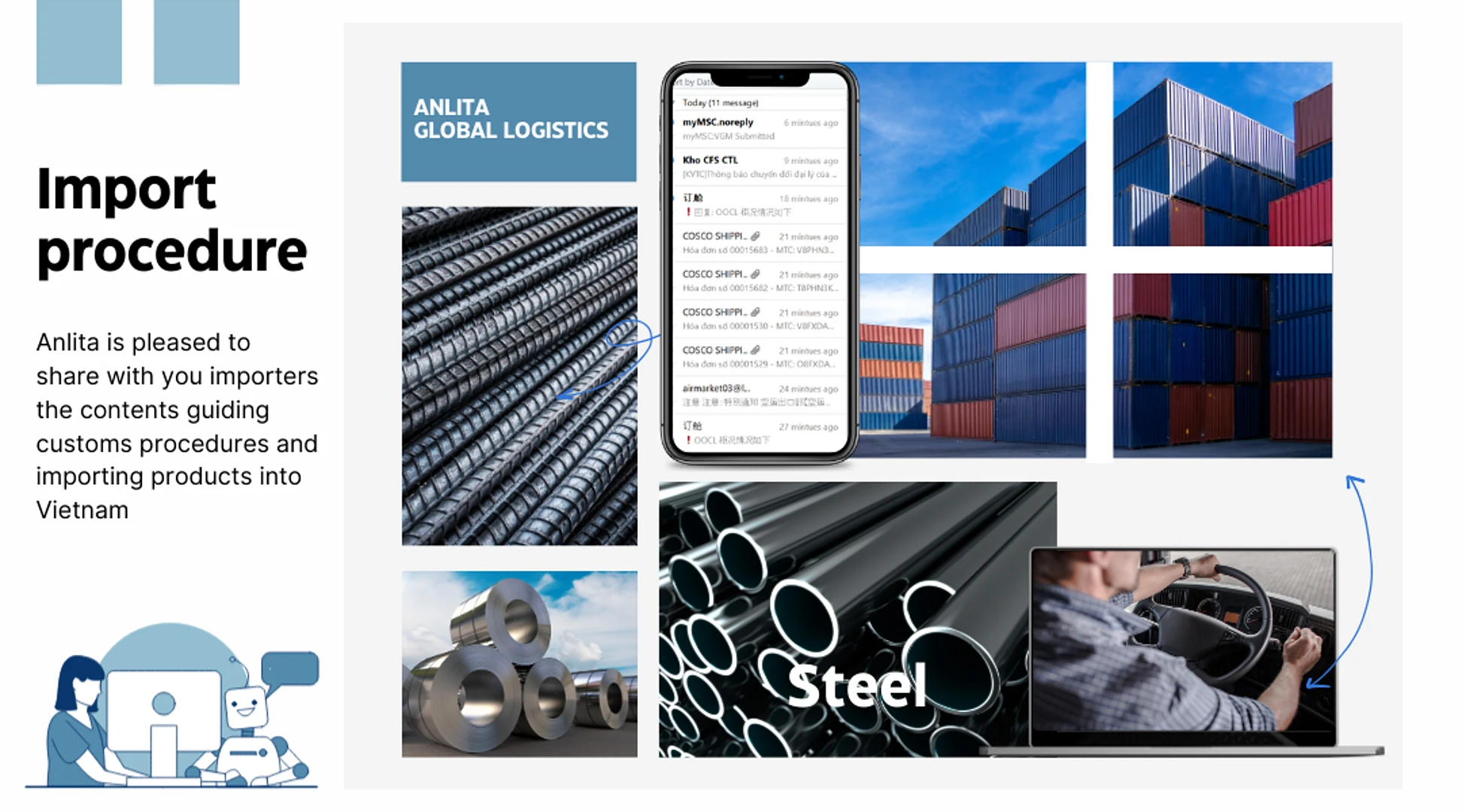
Steel import procedures, HS codes of steel, alloy steel, steel pipes, stainless steel, shaped steel, T-shaped steel I H V L Y, wire steel, steel plates, import tax, VAT and import policy of all types of steel. These are the main contents that Anlita wants to share with you in this article.
Iron and steel are materials used a lot in life, especially in construction. Steel is imported from many different countries around the world such as China, Japan, Korea, Malaysia. Steel is imported in many forms such as: rolls, bars, tubes, and plates. However, when carrying out procedures to import steel, it is divided into two types:
- New steel import procedures
- Procedures for importing used steel
Next, Anlita would like to share about procedures for importing steel of all types, HS codes of steel plates, square steel, round steel, rolled steel, I, H, V, L steel, import tax, VAT and policies Import all kinds of steel.
1. Steel import policy
1.1. Legal basis Steel is a commodity imported a lot into Vietnam, mainly for construction purposes. Procedures for importing steel of all types are specified in the following legal documents:
- Circular 58/2015/TTLT-BCT-BKHCN dated December 31, 2015
- Circular 18/2017/TT-BCT dated September 21, 2017
- Circular 38/2015/TT-BTC dated March 25, 2015; Amended and supplemented 39/2018/TT-BTC dated April 20, 2018.
- Decree 69/2018/ND-CP dated May 15, 2018
- Decree No. 15/2018/ND-CP dated February 2, 2018
- Decision No. 583/QD-TCHQ dated March 22, 2019
- Decision 3390/QD-BCT dated December 21, 2020
- Decision 920/QD-BCT dated March 20, 2020
- Official dispatch 638/TCHQ-TXNK dated February 22, 2022
According to the legal documents above, it can be seen that new steel products are not on the list of goods banned from import. For used items, they must be imported as scrap. If you want to import, you must have an import license. There are many different types of steel and when carrying out import procedures, there will be different regulations for each type. The most important point of importing steel is to check the quality of imported goods. Besides, the import tax of steel is also very different, some types are subject to anti-dumping tax.
1.2. Policy on importing steel of all types
When importing steel into Vietnam, the following points must be noted:
- Must accurately determine the HS code of the imported steel;
- Some types of steel must be inspected for quality when imported;
- Some types of steel will be subject to anti-dumping tax and safeguard tax;
- There must be a steel mark on the product clearly stating the contents of the label.
The list of steel products subject to quality inspection is specified in Appendix II and III of Circular 58/2015/TTLT-BCT-BKHCN. Steel products that must be inspected for quality include the following:
| Annex II | |
| Product code | Product description |
| 7206 | Iron and non-alloy steel in ingots or other primary forms (excluding iron of heading 72.03) |
| 7207 | Semi-finished products of iron or non-alloy steel |
| 7208 | Flat-rolled products of iron or non-alloy steel, of a width of 600 mm or more, hot-rolled, not clad, plated or coated |
| 7209 | Flat-rolled products of iron or non-alloy steel, of a width of 600 mm or more, cold-rolled (cold-reduced), not clad, plated or coated |
| 7210 | Flat-rolled products of iron or non-alloy steel, of a width of 600 mm or more, clad, plated or coated |
| 7212 | Flat-rolled products of iron or non-alloy steel, of a width of less than 600 mm, clad, plated or coated |
| 7213 | Bars and rods, hot-rolled, in irregularly wound coils, of iron or non-alloy steel |
| 7214 | Other bars and rods of iron or non-alloy steel, not further worked than forged, hot-rolled, hot-drawn or hot-extruded, but including those twisted after rolling |
| 7215 | Other bars and rods of iron or non-alloy steel |
| 7216 | Angles, shapes and sections of iron or non-alloy steel |
| 7217 | Wire of iron or non-alloy steel |
| 7219 | Flat-rolled products of stainless steel, of a width of 600 mm or more |
| 7220 | Flat-rolled products of stainless steel, of a width of less than 600 mm |
| 7224 | Other alloy steel in ingots or other primary forms; semi-finished products of other alloy steel |
| 7225 | Flat-rolled products of other alloy steel, of a width of 600 mm or more |
| 7226 | Flat-rolled products of other alloy steel, of a width of less than 600 mm |
| 7227 | Bars and rods, hot-rolled, in irregularly wound coils, of other alloy steel |
| 7228 | Other bars and rods of other alloy steel; angles, shapes and sections, of other alloy steel; hollow drill bars and rods, of alloy or non-alloy steel |
| 7229 | Wire of other alloy steel |
| 7306 | Other tubes, pipes and hollow profiles (for example, open seam or welded, riveted or similarly closed), of iron or steel |
| Annex III | |
| 7207 | Semi-finished products of iron or non-alloy steel |
| 7210 | Flat-rolled products of iron or non-alloy steel, of a width of 600 mm or more, clad, plated or coated |
| 7224 | Other alloy steel in ingots or other primary forms; semi-finished products of other alloy steel |
| 7225 | Flat-rolled products of other alloy steel, of a width of 600 mm or more |
| 7306 | Other tubes, pipes and hollow profiles (for example, open seam or welded, riveted or similarly closed), of iron or steel |
Above are all types of steel that must be inspected for imported quality according to Circular 58/2015/TTLT-BCT-BKHCN. We only give the HS code of the first 4 numbers, to know more clearly and in more detail about steel import procedures and HS code details that must be inspected for quality. Please contact our hotline or email for advice.
2. Label imported goods
Labeling imported goods is not a new regulation. However, since Decree 128/2020/ND-CP was issued, the labeling of imported goods has been more closely monitored. Labeling goods is intended to help administrative agencies manage goods, determine the origin and unit responsible for the goods. Therefore, labeling goods is one of the indispensable steps when carrying out procedures to import steel from different countries.
2.1. Label content
In addition to labeling, label content is also very important. Label content of goods is regulated in Decree No. 43/2017/ND-CP. For steel products, the content of a full label includes the following information:
- Information of the exporter (address, company name);
- Information of the importer (address, company name);
- Product name and product information;
- Origin of goods.
Those are the basic label contents that need to be affixed to the goods. Information must be presented in English; other languages must be translated. When carrying out steel import procedures, if you encounter a red channel, customs inspection will pay close attention to the label content above.
2.2. Label position on goods
Sticking labels on goods is necessary, but sticking them in the right position is more important. When importing, product labels need to be affixed to the surfaces of the package such as cartons, wooden packages or product packaging, or anywhere that is convenient to check and easy to see. Labeling in the right location will help save inspection time when carrying out procedures to import steel of all kinds.
For retail goods on the market, more information needs to be shown, such as the manufacturer, quantity of goods, technical specifications, date of manufacture, safety warnings.
2.3. Risks encountered when not labeling
Failing to label goods is illegal. If the goods are not labeled when imported or the label content is incorrect, importers face the following risks:
- Being fined according to regulations, the penalty level is specified in Article 22 of Decree 128/2020/ND-CP;
- Not entitled to special preferential import tax because the certificate of origin will be rejected;
- Goods are easily lost or damaged because there are no warning labels for loading, unloading and transportation.
With the above risks, we recommend that you put labels on the goods when carrying out iron and steel import procedures. If you do not fully understand the regulations on product labels, please contact our hotline or email for advice.
3. Determine the HS code of imported iron and steel
Looking up HS codes is the most important task before carrying out iron and steel import procedures. To be able to accurately determine the HS code, it is necessary to understand the properties, components, functions, and materials used to produce the product.
3.1. HS code of steel types
HS code (Harmonized System) is a series of codes used for all goods worldwide. Between different countries in the world, only the ending numbers differ. Therefore, the first 6 numbers of the HS code worldwide for an item are the same. The HS code of iron and steel is divided into two chapters in the import and export tariff as follows:
Chapter 72: Iron and Steel;
Chapter 73: Articles of iron or steel.
To accurately determine the HS code, it is necessary to learn about the product’s characteristics and its description in the import-export tariff. For iron and steel products, you need to pay attention when looking up the HS code to determine the size, type of stainless steel or regular steel, cold rolled or hot rolled, alloy or non-alloy. There are many factors that can cause you to misidentify the HS codes of steel and steel products.
3.2. Risks when applying the wrong HS code
Determining the correct HS code is very important when carrying out import procedures for steel and steel products. Misidentifying the HS code will bring certain risks to you such as:
- Delaying customs procedures: Declaring the wrong HS code can lead to delays in customs procedures, because it takes time to check and verify accurate information about the type of goods.
- Delayed delivery: If the goods are found to have an incorrect HS code declared, the customs authority may request correction or clarification of the information. This can lead to delays in delivery and affect the production and business cycle of the business.
- Penalties for declaring incorrect HS codes according to Decree 128/2020/ND-CP;
- In case of import tax, you will face a penalty of at least 2,000,000 VND and a maximum penalty of 3 times the tax amount.
To accurately determine the HS code for each specific type of iron and steel, please contact our hotline or email for advice.
4. Import tax on steel of all kinds
Import tax is an obligation that the importer must fulfil when importing goods to Vietnam. There are two main types of import tax on steel products: import tax and import VAT. In addition, some HS codes also have anti-dumping taxes and self-defense taxes.
How to calculate tax when carrying out procedures to import steel of all types as follows:
- safeguard tax on steel products safeguard tax = CIF value x % of safeguard tax rate
- Anti-dumping tax Anti-dumping tax = CIF value x % anti-dumping tax rate
- Import tax Import tax = CIF value x % import tax rate
- Import VAT is determined according to the formula:
- Value added tax = (CIF value + Import tax + Safeguard tax + Anti-dumping tax) x % VAT rate.
According to the above formula, it can be seen that the import tax on steel of all types depends on the tax rate according to the HS code. To get the lowest and most accurate tax rate, you must determine the correct HS codes of steel types. Besides, it also depends on whether the shipment has a certificate of origin or not, to enjoy special preferential tax rates.
Anti-dumping tax and safeguard tax depend on each specific type of steel. Regulated according to different steel HS codes. Safeguard tax is adjusted according to Decision 918/QD-BCT, anti-dumping tax is adjusted according to Decision 3162/QD-BCT.
5. Documents for steel import procedures
The dossier set for importing steel of all types includes the following documents:
- Customs declaration
- Commercial contract (Sale contract) Packing list
- Commercial invoice
- Bill of lading
- Certificate of origin (if any)
- Check the quality of imported goods
- Catalog (if any), and other documents if required by customs.
Above are all documents used to carry out customs clearance procedures for shaped steel, wire steel, and other type steel. The most important are customs declarations, commercial invoices, bills of lading, and certificates of origin. Other documents will be added if requested by the Customs authorities.
If you do not understand the above documents, please contact our hotline or email for advice.
6. Imported steel quality inspection process
Most imported steel materials must be inspected for quality. The quality inspection of imported steel is under the management of the Ministry of Science and Technology, regulated according to Circular 58/2015/TTLT-BCT-BKHCN. The following is the process for checking the quality of steel imported into Vietnam.
Step 1. Register information on the one-stop system
To register documents for quality inspection of imported goods. First, you must have an account on the national one-stop site vnsw.gov.vn. Once you have an account, you can enter data and register for quality testing.
The registration dossier will be managed by the Department of Standards, Metrology and Quality. Each locality will have its own management department to facilitate steel import procedures.
Step 2. Sampling and quality checking
After the application is accepted on the national single-window information portal. Then you can contact the quality control unit to take samples and test them. Choosing a sample testing unit depends on the business. However, the unit must still be on the list approved by the Ministry of Science and Technology.
Step 3. Receive results and upload results to the one-stop site.
Once you have the quality test results, you can upload the results to the one-stop information portal to complete procedures for importing all kinds of steel.
This result can be uploaded by the testing center or uploaded by the business itself using its account.
Above are three basic steps to carry out imported steel quality inspection procedures. Quality inspection depends on the HS code of the imported steel. If you do not understand the process of quality inspection and steel import procedures, please contact our hotline or email for advice.
7. Steel import procedures
Procedures for importing steel and steel products as well as many other items are specifically stipulated in Circular 38/2015/TT-BTC dated March 25, 2015, amended and supplemented 39/2018/TT-BTC dated April 20, 2018. We summarize the steps in a short description so you can get an overall picture. The procedure for importing shaped steel, I H T V L Y steel, pipe steel, alloy steel, and rebar of all kinds includes the following steps:
Step 1. Declare the customs declaration
After having all import and export documents: Contract, commercial invoice, packing list, bill of lading, certificate of origin, notification of arrival and determining the steel HS code, you can then enter declaration information into the customs system via software. After having the customs declaration, you can register quality inspection documents on the national single-window system. According to each type of steel, there are types that do not require quality inspection.
Declaring customs declarations on customs software. Requires importers to have an understanding of data entry into the software. Do not arbitrarily declare customs declarations when you do not clearly understand this work. Arbitrary declaration can easily lead to irreparable points on the customs declaration. Then it will take a lot of money and time to fix.
Within 30 days from the date the goods arrive at the port, the customs declarant must declare the customs declaration. If this deadline is exceeded, the importer must face fines from customs.
Step 2. Open the customs declaration
After completing the customs declaration, the customs system will return the results of declaration classification. Once the declaration channel is assigned, print out the declaration and bring the import dossier to the customs department to open the declaration. Depending on the green, yellow and red channels, follow the steps to carry out import procedures for I-shaped H L V Y steel, pipe steel, round steel, and stainless steel.
The opening of the declaration must be carried out as soon as possible, at the latest within 15 days from the date of declaration. The declarant must bring documents to the Customs Branch to open the customs declaration. If the declaration exceeds 15 days, the declaration will be canceled and you will have to face customs fines.
Step 3. Customs clearance of goods
After checking the documents, if there are no questions, the customs officer will accept the customs declaration. You can now pay import tax for the customs declaration to clear the goods.
In some cases, the declaration will be released to bring the goods to the warehouse for preservation first. After completing all documents, customs will proceed to clear the customs declaration. When the declaration has not yet been cleared, procedures must be carried out to clear the declaration. If it is overdue, you will have to face penalty fees and it will take a lot of time.
Step 4. Bring the goods for preservation and use.
Upon customs clearance, proceed with the liquidation of the declaration and carry out the necessary procedures to bring the goods to the warehouse. To be able to bring goods to the warehouse, you need to prepare in advance a delivery order, a pick-up note at the port, and arrange a vehicle to pick up the goods. Avoid the situation where the declaration has been completed but there is an order from the shipping company to take the goods out of the port.
Above is the procedure for importing steel and steel products. If you do not understand the process steps, please contact us via hotline or email for advice.
8. Things to note when carrying out steel import procedures
In the process of carrying out steel import procedures for customers, Anlita has gained experience that we want to share with you. When carrying out steel import procedures, you need to note the following points:
- Import tax is an obligation to the state.
- Raw steel has many different HS codes, in addition to safeguard tax and anti-dumping tax. Need to check carefully before importing to avoid unexpected taxes.
- Value added tax for steel products is 10%.
- When importing steel, goods must be labeled according to 43/2017/ND-CP;
- Determine the correct HS code to determine the correct tax and avoid penalties.
- You should prepare documents before importing goods. This avoids extra storage costs.
Those are the notes that we want to send to you for your reference. If you find it useful, you can share it with your friends for reference. If there are any inappropriate points, please give us feedback so we can improve the article.
9. Conclusion
Above is all about steel import procedures, HS codes of stainless steel, alloy steel, I H T L V Y steel, round steel, steel plates, import tax, VAT, import policy and quality inspection of all types of steel. Hopefully this article will bring the information you are looking for.
Procedure for importing microwave oven
Microwave oven import procedures, HS code, import tax, VAT and microwave oven import policy. These are the main contents that Anlita wants to share with you in this article. Microwave ovens are household thermoelectric devices, used quite commonly in today’s life. Microwave ovens are imported from many different countries to Vietnam such as: China, Korea, Japan, Europe, America, Thailand.
Next, Anlita would like to send you the content of the microwave oven import procedure, HS code, import tax, VAT and microwave oven import policy. Please refer to the main content below:
1. Microwave oven import policy
The procedure for importing microwave ovens is regulated in the following legal documents:
- VAT Law 13/2008/QH12 dated June 3, 2008;
- Official Dispatch No. 1488/TĐC-DGPH dated October 21, 2009;
- Official dispatch 6061/TCHQ-TXNK dated June 29, 2016
- Decision 04/2017/QD-TTg dated March 9, 2017;
- Circular 38/2015/TT-BTC dated March 25, 2015, amended and supplemented 39/2018/TT-BTC dated April 20, 2018;
- Decision No. 3810/QD-BKHCN dated December 18, 2019;
- Decree 69/2018/ND-CP dated May 15, 2018;
- Circular No. 09/2019/TT-BKHCN dated September 30, 2019;
- Decree 128/2020/ND-CP dated October 19, 2020.
According to the above legal documents, it can be seen that microwave ovens are not on the list of goods banned from import. However, used microwave ovens are on the list of prohibited imports.
Also according to the legal documents above, quality inspection must be carried out when importing microwave ovens according to decision 3810/QD-BKHCN.
Above are all legal documents regulating the procedure for importing microwave ovens. There may be some other additional documents that we hope to receive contributions from readers. If you have any questions or comments, please contact the hotline or email for advice.
2. Label imported goods
Labeling imported goods is not a new regulation. However, since Decree 128/2020/ND-CP was issued, the labeling of imported goods has been more closely monitored. Labeling goods is intended to help administrative agencies manage goods, determine the origin and unit responsible for the goods. Therefore, labeling goods is one of the indispensable steps when carrying out procedures to import microwave ovens from different countries.
2.1. Label content
In addition to labeling, label content is also very important. Label content of goods is regulated in Decree No. 43/2017/ND-CP. For microwave oven products, the content of a full label includes the following information:
- Information of the exporter (address, company name);
- Information of the importer (address, company name);
- Product name and product information;
- Origin of goods.
Those are the basic label contents that need to be affixed to the goods. Information must be presented in English; other languages must be translated. When carrying out procedures to import microwave ovens, if you encounter a red channel, customs inspection will pay close attention to the label content above.
2.2. Label position on goods
Sticking labels on goods is necessary, but sticking them in the right position is more important. When importing, product labels need to be affixed to the surfaces of the package such as cartons, wooden packages or product packaging, or anywhere that is convenient to check and easy to see. Labeling in the correct location will help save inspection time when carrying out import procedures for microwave ovens of all types.
For retail goods on the market, more information needs to be shown, such as the manufacturer, quantity of goods, technical specifications, date of manufacture, safety warnings.
2.3. Risks encountered when not labeling
Failing to label goods is illegal. If the goods are not labeled when imported or the label content is incorrect, importers face the following risks:
- Being fined according to regulations, the penalty level is specified in Article 22 of Decree 128/2020/ND-CP;
- Not entitled to special preferential import tax because the certificate of origin will be rejected;
- Goods are easily lost or damaged because there are no warning labels for loading, unloading and transportation.
With the above risks, we recommend that you put labels on the goods when carrying out procedures to import microwave ovens. If you do not fully understand the regulations on product labels, please contact our hotline or email for advice.
3. Microwave oven HS code
Looking up HS codes is the first thing to do when importing microwave ovens. The first 4 to 6 digits of an item’s HS code are the same worldwide. Therefore, when doing import procedures, you can refer to the HS code provided by the seller.
Next, Anlita would like to introduce to you the HS code of microwave ovens. Please follow the detailed table below.
|
Product
code |
Product
description |
Normal
import tax |
Preferential
import tax |
VAT |
ACFTA
(CO |
ATIGA
(CO |
|
|
|
85165000 |
– Microwave ovens |
37.5 |
25 |
10 |
5
(-TH) |
0 |
According to the description above, the HS code of the microwave is: 85165000. Preferential import tax on microwave ovens is 37.5%, import VAT is 10%.
Also according to this HS code, microwave oven products will have to undergo import quality inspection when imported. However, if the microwave uses power sources such as solar power, wind power, or water power, there will be no need to do quality testing.
In addition to these tax rates, there are also special preferential import taxes. This tax rate applies to goods imported from countries and territories with which Vietnam has signed trade agreements such as: Eastern Europe, Europe, America, Chile, Korea, China, Japan and ASEAN countries.
To learn about special preferential tax rates and advice on the procedure for importing microwave ovens. Please contact our hotline or email for advice.
4. Import tax on microwave ovens
Import tax is considered a part of the cost that will have to be added to the cost of goods sold of the business. Import tax is an obligation to the state that importers must fulfill. There are two types of import tax: VAT and import tax.
To determine the import tax and VAT of microwave ovens. Please refer to the calculation formula below.
- Import tax is determined according to HS code. Import tax is calculated according to the formula:
Import tax = CIF value x % tax rate
CIF value is determined by the ex-factory value of the goods, plus all costs to bring the goods to the first border gate of the importing country.
- Import VAT is determined according to the formula:
Value added tax = (CIF value + Import tax) x % tax rate.
According to the above formula, import tax depends on import tax rate. The import tax rate depends on the microwave HS code selected above.
Besides, as mentioned above, for goods imported from countries and regions with which Vietnam has signed trade agreements, the import tax is usually 0%. Therefore, when negotiating a transaction, the buyer should ask the seller to provide a certificate of origin.
If you do not understand the certificate of origin and import tax for microwave ovens, please contact our hotline or email for advice.
5. Microwave oven import documents
Documentation for import procedures for microwave ovens in particular and other items in general are regulated in Circular 38/2015/TT-BTC dated March 25, 2015; Amended and supplemented 39/2018/TT-BTC dated April 20, 2018.
The dossier set for importing microwave ovens includes the following documents:
- Customs declaration;
- Commercial invoice;
- Bill of lading;
- Packing list;
- Commercial contract (Sale contract);
- Quality inspection registration dossier;
- Certificate of origin (C/O) if any;
- Catalog (if any).
In the above set of documents, the following documents are the most important: Customs declaration, bill of lading, commercial invoice and registration dossier for quality inspection of imported microwave ovens. For other documents, they will be added when requested by customs.
There are two forms of quality inspection dossiers: direct paper dossier submission and electronic dossier submission through the national single-window information portal. Quality inspection documents are required when carrying out procedures to import microwave ovens. Therefore, as soon as you have the customs declaration number, you must register the quality inspection file to avoid prolonging the time.
If you do not fully understand the above documents, please contact our hotline or email for advice.
6. Microwave oven import process
Procedures for importing microwave ovens as well as many other items are specifically stipulated in Circular 38/2015/TT-BTC dated March 25, 2015, amended and supplemented 39/2018/TT-BTC dated April 20, 2018. We summarize the steps in a short description so you can get an overall picture.
Below are the main steps to carry out procedures to import microwave ovens of all types.
Step 1: Fill out the customs declaration
After having all import and export documents: Contract, commercial invoice, packing list, bill of lading, certificate of origin, arrival notice and determining the HS code of the microwave, you can then enter declaration information into the customs system via software.
Step 2: Open the customs declaration
After completing the customs declaration, the customs system will return the declaration classification results. Once the declaration channel is assigned, print out the declaration and bring the import dossier to the customs department to open the declaration. Depending on the green, yellow, and red channel, follow the steps to open the declaration.
Step 3. Clear customs declaration
After checking the documents, if there are no questions, the customs officer will accept customs clearance of the declaration. You can now pay import tax for the customs declaration to clear the goods.
Step 4. Bring the goods to the warehouse for preservation and use
Upon customs clearance, proceed with the liquidation of the declaration and carry out the necessary procedures to bring it back to the warehouse.
Conducting sampling to check microwave quality. This can be done at the port or samples can be taken at the importer’s warehouse.
Above are 4 basic steps to carry out procedures to import microwave ovens. In addition, there are many business details that we have not mentioned here. Please contact Anlita for advice.
7. Register to check microwave oven quality
When carrying out import procedures, microwave ovens must register for quality inspection as prescribed in Decision No. 3810/QD-BKHCN. Quality inspection registration documents can be made on paper or on the national one-stop information portal.
Next, Anlita will introduce to you the steps to register for quality inspection for microwave oven products on the national one-stop system.
Step 1: Create an account and register profile
Creating an account on the national one-stop site is the first step when registering for quality inspection. To create an account on the national one-stop site, you must visit the website https://vnsw.gov.vn. Enter data according to the available information boxes to create an account.
After having an account, you can register on the national one-stop site. At the management part of the Ministry of Science and Technology. When registering documents, the Department of Standards, Metrology and Quality will be the unit receiving the documents. You must choose a sample testing unit, a sample testing unit licensed by the Ministry of Science and Technology.
You can create the account and register before importing. You should create an account in advance because it usually takes 24 hours for the account to be approved.
Step 2: Take samples and check quality
After having the registration dossier number, check the quality. Customs can then clear the goods. Sampling to check quality can be done at the port or at the importer’s warehouse.
Samples will be taken according to regulations to check quality. Quality inspection time according to TCVN. Depending on the laboratory, it usually takes 2-3 days for test results to be available.
Step 3: Receive results and upload results to the national one-stop site
When the quality inspection results are available, the importer or sample inspection unit can upload the results to the national single-window system. After receiving the results, the Department of Standards and Measurement will accept or reject the registration application.
Above are three basic steps to register for microwave oven quality inspection. If you do not understand the quality inspection registration process, please contact the hotline or email for advice.
8. Notes when importing microwave ovens
During the process of importing microwave ovens for customers, We have learned some experiences that we would like to share with you. The following are the notes that Anlita wants to share for your reference.
Import tax is an obligation that the importer must fulfill with the state;
Used microwave ovens are on the list of goods banned from import;
Imported microwave ovens must undergo quality inspection.
Those are the notes that we want to send to you for your reference. If you find it useful, you can share it with your friends for reference. If there are any inappropriate points, please give us feedback so we can improve the article.
9. Conclusion:
Above are all the main contents about the microwave oven import procedure process, HS code, import tax, VAT and microwave oven import policy. Hopefully this article will bring you the information you are looking for. Any questions or requests for quotes for microwave oven import procedure services? Please contact our hotline or email for advice.
Procedure for importing medicinal material

In fact, pharmaceuticals are a type of product that is prioritized for import and continuous renewal to meet human needs. On the other hand, imported drugs are also increasing exponentially. Therefore, many customers are still wondering how pharmaceutical import procedures are carried out? So Anlita would like to answer for you through the article below:
1. Regulations on importing pharmaceuticals to Vietnam
Procedures for importing pharmaceuticals have been specifically stipulated in section 2, chapter 2, in compliance with Decree No. 54/2017/ND – CP (amended and supplemented by Decree No. 155/2018/ND – CP). In particular, drugs are only licensed for import when people fully meet the criteria such as:
- Licensed for circulation in the country of manufacture, member country of the International Council for Harmonization of Technical Requirements for Pharmaceuticals for Human Use – ICH or Australia.
- Guidelines for diagnosis, disease prevention, and treatment are available, issued and fully approved by the Ministry of Health.
- Medicines for emergency purposes, anti-toxicity, anti-graft rejection, etc.
- Medicines used to diagnose, prevent or promptly treat group A infectious diseases, cancer, HIV/AIDS, viral hepatitis, tuberculosis, malaria and other diseases decided by the Minister of Health.
- Comply with regulations on importing pharmaceuticals to Vietnam
2. Conditions for importing pharmaceuticals in Vietnam
In addition to being familiar with drug concepts, individuals, organizations or businesses must understand and comply with the conditions when carrying out pharmaceutical import procedures:
- Enterprises that produce and trade drugs are required to possess a certificate of eligibility to produce and trade pharmaceuticals in accordance with regulations.
- Professional managers of production and business establishments must be granted a pharmacy practice certificate. Not only that, they need to have professional ethics, practice health equipment and possess a certificate of eligibility to produce and trade drugs and pharmaceuticals.
- The enterprise’s facilities meet standards. At the same time, the unit receiving the operation must also improve its professional qualifications and correspond to the form of trading in imported pharmaceutical and drug products.
- Fully meets the conditions for importing pharmaceutical products
3. Legal procedures for importing pharmaceuticals to Vietnam
Currently, the legal document system already displays regulations on pharmaceutical import procedures. Specifically:
- Pharmacy Law announced in 2016.
- Decree 54/2017/ND – CP issued by the Government detailing a number of articles and measures to implement pharmaceutical law in 2016.
- According to Decree No. 155/2018/ND – CP amending and supplementing Decree No. 54/2017/ND – CP.
- Circular 03/2016/TT – BYT of the Ministry of Health provides general regulations on pharmaceutical business activities.
- Any related legal documents.
4. Documents and procedures for importing pharmaceuticals
Anlita explains the correct and complete pharmaceutical import procedures as follows:
- Import application paper (original).
- Import orders.
- Pharmaceutical product certificate (can be replaced by FSC and GMP). In cases where many facilities simultaneously cooperate in the drug production process, they are required to submit GMP certificates of all centers participating in the process of creating the finished product.
- Standards and methods for checking drug quality.
- The medicine label and instruction sheet are pre-stamped with the importer’s name. Includes 01 set of labels with original instructions for use currently in circulation in the place of origin (except vaccines and medical biological products), 02 sets of labels expected to be circulated in Vietnam with instructions for use translated into Vietnamese.
- Report drug inventory.
- Prepare clinical and pre-clinical documents for drugs containing new pharmaceutical substances or drugs with a combination of some already circulating pharmaceutical substances.
- Prepare accurate and complete import procedures documents
5. Detailed procedures for importing pharmaceuticals
When importing, businesses need to determine whether their pharmaceuticals have a circulation number in Vietnam or not. If not, the unit must apply for an import license and register a circulation number. Therefore, pharmaceutical import procedures are often divided into two types:
1. Procedures for importing pharmaceuticals with circulation numbers in Vietnam
For pharmaceuticals that already have a circulation number in Vietnam, businesses can directly carry out import procedures at the Customs office. Records include:
- Complete commercial invoice.
- Clear foreign trade contracts.
- Bill of lading attached.
- Certificate of origin (original).
- Providing operating licenses for drugs and medicinal ingredients in Vietnam.
- Complete list of imported drugs.
- Product circulation permit or Decision on issuance of circulation registration book (original or notarized photocopy).
2. Procedures for importing pharmaceuticals that do not have a circulation number in Vietnam
On the contrary, if the product does not have a circulation number, the unit must apply for an import license and register a circulation number. The sequence includes 3 steps:
Step 1: Apply for a pharmaceutical import license (required)
This is considered the most important step to import pharmaceuticals to register their circulation numbers in Vietnam. Therefore, businesses need to prepare documents to apply for an import license according to the form detailed in Clause 2, Article 65, Decree 54/2017/ND – CP. As follows:
- Import order Form No. 15, 16 or 17 in Appendix III attached to Decree No. 54/2017/ND – CP (03 originals).
- Pharmaceutical product certificate (original or certified copy).
- The manufacturer’s stamped copy of quality standards and drug testing methods (photo).
- Set of label samples and instructions for use being circulated in the country that issued the Pharmaceutical Product Certificate (1 original copy).
- Set of label samples expected to be circulated in Vietnam with Vietnamese instructions for use stamped by the import facility (2 sets).
- Report drug business results in case imported drugs are addictive drugs, psychotropic drugs, etc. according to Form No. 18 in issued Appendix III.
- Good practice certificates of all facilities participating in the production of imported drugs in case the drugs are produced by many different enterprises (original or notarized photocopy).
- License to carry out radiation work of the importing facility in case of importing radioactive drugs (certified copy or copy of the facility’s stamp).
Step 2: Register the pharmaceutical circulation number
As soon as the import documents are completed and submitted in accordance with legal regulations, the unit should begin the process of registering the circulation number for pharmaceuticals in Vietnam. On the other hand, registration procedures and documents are listed in Clause 2, Article 56 of the 2016 Pharmacy Law. The detailed summary is as follows:
Administrative records:
- Application for registration of circulation certificate and raw materials for drug processing.
- Authenticated copy of a valid representative office establishment license for a drug business establishment or a valid Certificate of eligibility for pharmaceutical business.
- Original or certified copy of valid Pharmaceutical Product Certificate for imported drugs.
- Sample labels, raw materials, drug information and other documents related to business, circulation and raw materials.
- Technical documents proving that drugs and medicinal ingredients must meet all requirements in Clause 4, Article 54 of the 2016 Pharmacy Law.
- New drugs, reference biological products, vaccines, etc. have indications for diseases on the list issued by the Minister of Health, so businesses must possess an additional set of clinical records proving safety and effectiveness.
- Similar biological products must have additional records demonstrating quality compared to a reference biological product.
- In addition, drugs requiring bioequivalence testing must have an additional report on bioequivalence study data of the drug.
Step 3: Make dossiers for importing pharmaceuticals
As Anlita just mentioned in the section “Documents and procedures for importing pharmaceuticals”, just completing this step is almost 100% complete.
3. HS code and pharmaceutical import tax
Complying with the legal regulations issued by the Vietnamese government, HS Code and taxes are recorded as follows:
HS Code
300410: Drug containing Penicillin with Penicillanic Acid structure.
300420: Drugs containing antibiotics.
300432: Drugs containing Adrenal Hormones or their derivatives.
300440: Drugs containing Alkaloids or their derivatives but do not contain Hormones and antibiotics.
300450: Medicines containing vitamins or products in heading 29.36.
30049049: Anti-malarial drugs, pain relievers, dewormers, etc.
Have full HS code and pay taxes according to regulations
4. Tax
As announced by the Department of Management, pharmaceutical imports are subject to VAT at a rate of 5% when completing customs declaration procedures.
5. Q&A frequently asked questions about pharmaceutical import procedures
Q: What requirements do Vietnamese establishments importing drugs need to meet?
A: The unit must fully meet the following criteria:
Issue a certificate of satisfaction of drug trading conditions with the scope of trading medicinal herbs.
Meets the principle of “Good medicine storage practices” strictly inspected by the Ministry of Health.
Q: How many stages does the procedure for importing pharmaceuticals that do not have a circulation number usually go through?
A: The answer is 3 stages:
First, apply for a pharmaceutical import license.
Second, register for circulation of pharmaceuticals in Vietnam.
Third, carry out customs procedures to import pharmaceutical products that already have a circulation number.
We hope this summary of pharmaceutical import procedures is helpful to you.
If you have any questions that you still don’t understand, contact the Hotline for advice and support!
Procedure for importing generator
Procedures for importing generators, HS codes of generator sets running on diesel engines, generators running on gasoline engines, natural gas generators, water generators, single-phase generators, 3-phase generators, DC generators, AC generators, import policy, VAT, import tax on generators. These are the main contents that Anlita wants to share with you in this article. A generator is a device that converts mechanical energy into electrical energy. It usually uses the principle of electromagnetic induction. Generators are imported from many different countries around the world such as Europe, Japan, America, Korea, China, Thailand. The import procedures for different types of generators are relatively similar.
Next, Anlita will share procedures for importing generators, HS codes for diesel generators, gasoline generators, water generators, AC generators, DC generators, 1-phase and 3-phase generators, import policy, import tax and VAT on generators of all types.
1. Generator import policy
Procedures for importing generators of all types are specified in the following legal documents:
Circular 38/2015/TT-BTC dated March 25, 2015; Amended and supplemented 39/2018/TT-BTC dated April 20, 2018.Decree 69/2018/ND-CP dated May 15, 2018;
- Decree No. 15/2018/ND-CP dated February 2, 2018;
- Decision No. 583/QD-TCHQ dated March 22, 2019;
- Decision 18/2019/QD-TTg dated April 19, 2019;
- Decree No. 43/2017/ND-CP dated April 14, 2017;
- Decree 128/2020/ND-CP dated October 19, 2020.
According to the above legal documents, generators do not belong to the list of goods banned from import. Procedures for importing generators will be carried out like other normal goods. When importing generators, it is necessary to note the following points:
- Used generators must be less than 10 years old;
- When importing generators, goods must be labeled according to 43/2017/ND-CP;
- Determine the correct HS code to determine the correct tax and avoid penalties.
Above are all legal regulations related to procedures for importing generators. If you do not fully understand the above processes, please contact the hotline or email for advice.
2. Label imported generators
Labeling imported goods is not a new regulation. However, since Decree 128/2020/ND-CP was issued, the labeling of imported goods has been more closely monitored. Labeling goods is intended to help administrative agencies manage goods, determine the origin and unit responsible for the goods. Therefore, labeling goods is one of the indispensable steps when carrying out procedures to import generators from different countries. Label content: In addition to labeling, label content is also very important. Label content of goods is regulated in Decree No. 43/2017/ND-CP. For generator products, the content of a full label includes the following information:
- Information of the exporter (address, company name);
- Information of the importer (address, company name);
- Product name and product information;
- Origin of goods.
Those are the basic label contents that need to be affixed to the goods. Information must be presented in English; other languages must be translated. When carrying out import procedures for generators, if you encounter a red channel, customs inspection will pay close attention to the label content above. Label position on goods: Sticking labels on goods is necessary, but sticking them in the right location is more important. When importing, product labels need to be affixed to the surfaces of the package such as cartons, wooden packages or product packaging, or anywhere that is convenient to check and easy to see. Labeling in the correct location will help save inspection time when carrying out import procedures for generators of all types.
For retail goods on the market, more information needs to be shown, such as the manufacturer, quantity of goods, technical specifications, date of manufacture, safety warnings. Risks of not labeling: failing to label goods is illegal.
If the goods are not labeled when imported or the label content is incorrect, importers face the following risks:
- Being fined according to regulations, the penalty level is specified in Article 22 of Decree 128/2020/ND-CP;
- Not entitled to special preferential import tax because the certificate of origin will be rejected;
- Goods are easily lost or damaged because there are no warning labels for loading, unloading and transportation.
With the above risks, we recommend that you put labels on the goods when carrying out procedures to import generators. If you do not fully understand the regulations on product labels, please contact our hotline or email for advice.
3. HS codes of generators of all types
To determine the HS code, it must be based on material, structure, size, and function. For generators, the HS code can be identified from its operating principle and use.
Here, Anlita has compiled the HS codes of generators of all types according to the table below:
|
Product
code |
Product
description |
Normal
import tax |
Preferential
import tax |
VAT |
ACFTA
(CO |
ATIGA
(CO |
|
|
|
|
– AC generators (alternators),
other than photovoltaic generators: |
|
|
|
|
|
||
|
850161 |
– – Of an output not exceeding 75
kVA: |
|
|
|
|
|
||
|
85016110 |
– – – Of an output not exceeding
12.5 kVA |
30 |
20 |
8 |
50 |
0 |
||
|
85016120 |
– – – Of an output exceeding 12.5
kVA |
30 |
20 |
8 |
50 |
0 |
||
|
850162 |
– – Of an output exceeding 75 kVA
but not exceeding 375 kVA: |
|
|
|
|
|
||
|
85016210 |
– – – Of an output exceeding 75
kVA but not exceeding 150 kVA |
10.5 |
7 |
8 |
0 |
0 |
||
|
85016220 |
– – – Of an output exceeding 150
kVA but not exceeding 375 kVA |
10.5 |
7 |
8 |
0 |
0 |
||
|
85016300 |
– – Of an output exceeding 375
kVA but not exceeding 750 kVA |
5 |
0 |
8 |
0
(-KH) |
0 |
||
|
85016400 |
– – Of an output exceeding 750
kVA |
5 |
0 |
8 |
0 |
0 |
According to the HS code table above, the import tax on generators and VAT on generators is 10%. In addition to the above preferential tax rates, there are many other special preferential tax rates.
If you have not determined the HS code of the generator you are importing, please contact our hotline or email for advice.
4. Import tax on generators
Import tax is an obligation that importers must fulfill when importing goods to Vietnam. There are two types of import tax for generators: Value added tax and import tax. To calculate import tax, please refer to the calculations below.
Tax calculation when carrying out import procedures for generators of all types is as follows:
- Import tax is determined according to HS code. Import tax is calculated according to the formula:
Import tax = CIF value x % tax rate
- Import VAT is determined according to the formula:
Value added tax = (CIF value + Import tax) x % VAT rate.
According to the above formula, it can be seen that the import tax on generators of all types depends on the tax rate according to the HS code. To get the lowest and most accurate tax rate, you must determine the correct HS code for generators of all types. Besides, it also depends on whether the shipment has a certificate of origin or not, to enjoy special preferential tax rates.
For goods imported from countries such as Europe, India, Australia, Chile, China, Korea, Japan, ASEAN countries. Importers should ask sellers to provide them with a certificate of origin to enjoy the lowest import tax rate for generators of all types.
5. Dossier set for importing generators of all types
The dossier set for importing generators of all types includes the following documents:
- Customs declaration
- Sales contract
- Packing list
- Commercial invoice
- Bill of lading
- Certificate of origin (if any)
- Catalog (if any), and other documents if required by customs.
Above are all documents used to complete customs clearance procedures for DC, AC, single-phase, three-phase generators and other types. The most important are customs declarations, commercial invoices, bills of lading, and certificates of origin. Other documents will be added if requested by the Customs authorities.
If you do not understand the above documents, please contact our hotline or email for advice.
6. Procedures for importing generator sets
The procedure for importing generators of all types includes the following steps:
Step 1. Fill out the customs declaration
After having all import and export documents: Contract, commercial invoice, packing list, bill of lading, certificate of origin, arrival notice and determining HS codes of generators of all types, you can then enter declaration information into the customs system via software.
Step 2. Open the customs declaration
After completing the customs declaration, the customs system will return the declaration classification results. Once the declaration channel is assigned, print out the declaration and bring the import dossier to the customs department to open the declaration. Depending on the green, yellow, and red channel, follow the steps to carry out import procedures for generators of all types.
Step 3. Customs clearance of goods
After checking the documents, if there are no questions, the customs officer will accept customs clearance of the declaration. You can now pay import tax for the customs declaration to clear the goods.
Step 4. Bring the goods back for storage and use
Upon customs clearance, proceed with the liquidation of the declaration and carry out the necessary procedures to bring the goods to the warehouse.
Above are four basic steps to carry out procedures to import generators of all types. If you do not understand the process, please contact the hotline or email for advice.
7. Notes when completing procedures to import generators
In the process of carrying out procedures to import generators of all kinds for customers, Anlita has gained experience that we want to share with you. When carrying out procedures to import generators, you need to note the following points:
- Import tax is an obligation to the state;
- Correctly determining the generator HS code is very important to determine tax and avoid penalties for applying the wrong HS code;
- You should prepare documents before importing goods. Avoid warehousing and storage that incur costs;
- When importing generators, goods must be labeled;
- Used generators are allowed to be imported provided that the equipment age is not more than 10 years old;
- Goods can only be sold on the market once the customs declaration has been cleared.
Above are the procedures for importing generators, HS codes for generators running on diesel engines, generators running on gasoline engines, natural gas generators, water generators, single-phase generators, 3-phase generators, DC generator, AC generator, import tax on generators, VAT and import policy on generators of all types. Hopefully this article will bring the information you are looking for.
Any questions, requests for advice, requests for quotes for import procedures for generator sets of all types? Please contact the hotline for advice!
Procedure for importing fertilizer
Fertilizer import procedures, HS code, import tax, VAT, import policy, quality inspection and announcement of circulation of fertilizers. These are the main contents that Anlita wants to share with you in this article. Fertilizer is “food” added by humans to plants. Fertilizer contains many nutrients necessary for plants. The main nutrients in fertilizer are: nitrogen, phosphorus, and potassium, called the macronutrient group. Fertilizers are also imported from many different countries into Vietnam such as China, Russia, Canada, America, Thailand, India, Japan. The following is the main content of the fertilizer import procedure process, HS code, import tax, import policy and quality inspection of imported fertilizer.
1. Fertilizer import policy
The procedure for importing fertilizers is regulated in the following legal documents:
- VAT Law 13/2008/QH12 dated June 3, 2008;
- Decree 113/2017/ND-CP dated October 9, 2017;
- Decree No. 108/2017/ND-CP September 20, 2017;
- Circular 38/2015/TT-BTC dated March 25, 2015;
- Amended and supplemented 39/2018/TT-BTC dated April 20, 2018;
- Decree No. 69/2018/ND-CP dated May 15, 2018;
- Decree No. 84/2019/ND-CP dated November 14, 2019;
According to the above documents, fertilizer products are not on the list of goods banned from import. However, when importing fertilizers, you need to pay attention to the following points:
- Must make a declaration of circulation of imported fertilizers;
- Must check the quality of imported fertilizers;
- Fertilizers are not subject to VAT when imported.
Above are the regulations on fertilizer import procedures. If you do not understand the above regulations, please contact the hotline or email for advice.
2. Look up fertilizer HS code
Looking up HS codes is an important task to do when carrying out fertilizer import procedures. HS code is a series of numbers that is conventionally assigned to each type of product globally. Therefore, when importing, buyers should refer to the HS code from the seller. Below are some HS codes of common fertilizers. Please refer to the detailed table below:
Product code | Product description | Normal import tax | Preferential import tax | VAT | ACFTA (CO | ATIGA (CO |
| |
31010010 | – Of solely vegetable origin | 5 | 0 | 5 | 0 | 0 | ||
| – Other: |
|
|
|
|
| ||
31010092 | – – Of animal origin (other than guano), chemically treated | 5 | 0 | 5 | 0 | 0 | ||
31010099 | – – Other | 5 | 0 | 5 | 0 | 0 | ||
3102 | Mineral or chemical fertilisers, nitrogenous |
|
|
|
|
| ||
31021000 | – Urea, whether or not in aqueous solution | 9 | 6 | 5 | 5 | 0 | ||
| – Ammonium sulphate; double salts and mixtures of ammonium sulphate and ammonium nitrate: |
|
|
|
|
| ||
31022100 | – – Ammonium sulphate | 5 | 0 | 5 | 0 | 0 | ||
31022900 | – – Other | 5 | 0 | 5 | 0 | 0 | ||
31023000 | – Ammonium nitrate, whether or not in aqueous solution | 4.5 | 3 | 5 | 0 | 0 | ||
31024000 | – Mixtures of ammonium nitrate with calcium carbonate or other inorganic non-fertilising substances | 5 | 0 | 5 | 0 | 0 | ||
31025000 | – Sodium nitrate | 5 | 0 | 5 | 0 | 0 | ||
31026000 | – Double salts and mixtures of calcium nitrate and ammonium nitrate | 5 | 0 | 5 | 0 | 0 | ||
31028000 | – Mixtures of urea and ammonium nitrate in aqueous or ammoniacal solution | 5 | 0 | 5 | 0 | 0 | ||
31029000 | – Other, including mixtures not specified in the foregoing subheadings | 5 | 0 | 5 | 0 | 0 | ||
3103 | Mineral or chemical fertilisers, phosphatic |
|
|
|
|
| ||
| – Superphosphates: |
|
|
|
|
| ||
310311 | – – Containing by weight 35% or more of diphosphorus pentaoxide (P2O5): |
|
|
|
|
| ||
31031110 | – – – Feed grade | 9 | 6 | 5 | 5 | 0 | ||
31031190 | – – – Other | 9 | 6 | 5 | 5 | 0 | ||
310319 | – – Other: |
|
|
|
|
| ||
31031910 | – – – Feed grade | 9 | 6 | 5 | 5 | 0 | ||
31031990 | – – – Other | 9 | 6 | 5 | 5 | 0 | ||
310390 | – Other: |
|
|
|
|
| ||
31039010 | – – Calcined phosphatic fertilisers | 9 | 6 | 5 | 5 | 0 | ||
31039090 | – – Other | 5 | 0 | 5 | 0 | 0 | ||
3104 | Mineral or chemical fertilisers, potassic |
|
|
|
|
| ||
31042000 | – Potassium chloride | 5 | 0 | 5 | 0 | 0 | ||
31043000 | – Potassium sulphate | 5 | 0 | 5 | 0 | 0 | ||
31049000 | – Other | 5 | 0 | 5 | 0 | 0 | ||
3105 | Mineral or chemical fertilisers containing two or three of the fertilising elements nitrogen, phosphorus and potassium; other fertilisers; goods of this Chapter in tablets or similar forms or in packages of a gross weight not exceeding 10 kg |
|
|
|
|
| ||
310510 | – Goods of this Chapter in tablets or similar forms or in packages of a gross weight not exceeding 10 kg: |
|
|
|
|
| ||
31051010 | – – Superphosphates and calcined phosphatic fertilisers | 9 | 6 | 5 | 0 | 0 | ||
31051020 | – – Mineral or chemical fertilisers containing two or three of the fertilising elements nitrogen, phosphorus and potassium | 9 | 6 | 5 | 0 | 0 | ||
31051090 | – – Other | 5 | 0 | 5 | 0 | 0 | ||
31052000 | – Mineral or chemical fertilisers containing the three fertilising elements nitrogen, phosphorus and potassium | 9 | 6 | 5 | 0 (-CN) | 0 | ||
31053000 | – Diammonium hydrogenorthophosphate (diammonium phosphate) | 9 | 6 | 5 | 5 | 0 | ||
31054000 | – Ammonium dihydrogenorthophosphate (monoammonium phosphate) and mixtures thereof with diammonium hydrogenorthophosphate (diammonium phosphate) | 5 | 0 | 5 | 0 | 0 | ||
| – Other mineral or chemical fertilisers containing the two fertilising elements nitrogen and phosphorus: |
|
|
|
|
| ||
31055100 | – – Containing nitrates and phosphates | 5 | 0 | 5 | 0 | 0 | ||
31055900 | – – Other | 5 | 0 | 5 | 0 | 0 | ||
31056000 | – Mineral or chemical fertilisers containing the two fertilising elements phosphorus and potassium | 5 | 0 | 5 | 0 | 0 | ||
31059000 | – Other | 5 | 0 | 5 | 0 | 0 |
Above are some popular inorganic and organic fertilizer HS codes. In addition to the above HS codes, there are many fertilizer HS codes that have not been mentioned. If you have not found the appropriate HS code for the type of goods you import, please contact our hotline or email for advice.
3. Fertilizer import tax
Import tax is an obligation that importers must fulfill towards the state. There are two types of import tax: VAT and import tax. To determine these tax rates, you can refer to the following tax calculation:Import tax is determined according to HS code.
- Import tax is calculated according to the formula:
Import tax = CIF value x % import tax rate
- Import VAT is determined according to the formula:
Value added tax = (CIF value + Import tax) x VAT rate.
CIF value is determined by the ex-factory value of the goods plus all costs to bring the goods to the first border gate of the importing country. For fertilizer products, the VAT is 0, so at this time there is only import tax. Regulated in 26/2015/TT-BTC dated February 27, 2015. Special preferential tax rates apply to goods imported from countries and territories with which Vietnam has signed trade agreements such as: China, Japan, Korea, Asian countries, India, Australia, Europe, Chile. To apply for special preferential import tax rates, a certificate of origin is required. Therefore, when importing goods from the above countries, buyers should ask the seller to provide a certificate of origin.
4. Documentation for importing fertilizers
Set of documents for importing fertilizers in particular and importing procedures for other goods in general are regulated in Circular 38/2015/TT-BTC dated March 25, 2015; Amended and supplemented 39/2018/TT-BTC dated April 20, 2018.
- Customs declaration;
- Commercial invoice;
- Bill of lading;
- Packing list;
- Commercial contract (Sale contract);
- Certificate of origin (C/O) if any;
- Records of announcement of circulation;
- Quality inspection registration dossier.
In the dossier for carrying out the above fertilizer import procedures and the above fertilizer import tax, the following documents are the most important: Customs declaration, commercial invoice, bill of lading, and archived declaration documents. operation and quality control. The circulation announcement dossier is considered an import license. This document is required to import fertilizer, so this document must be completed first. Other documents will have to be supplemented upon request from customs. Certificate of origin is an optional document. However, to enjoy special preferential import tax rates, the buyer should ask the seller to provide it. The special preferential import tax rate is usually 0%. If you do not fully understand the above documents, please contact the hotline or email for advice.
5. Procedures for importing fertilizers
Procedures for importing fertilizers in particular and procedures for importing other goods in general are specifically stipulated in Circular 38/2015/TT-BTC dated March 25, 2015, amended and supplemented 39/2018/TT-BTC dated April 20, 2018. The following are the steps to carry out procedures to import fertilizer:
Step 1: Fill out the customs declaration
After having complete import and export documents: Contract, commercial invoice, packing list, bill of lading, certificate of origin, arrival notification and determining the fertilizer HS code, you can then enter declaration information into the customs system via software.
Step 2: Register for quality inspection and quarantine
Registering for quality inspection is a mandatory step when carrying out fertilizer import procedures. Quality inspection is registered on the national one-stop system. Fertilizers are under the management of the Ministry of Agriculture.
Step 3: Open the customs declaration
After completing the customs declaration, the customs system will return the declaration classification results. Once the declaration channel is assigned, print out the declaration and bring the import dossier to the customs department to open the declaration. Depending on the green, yellow, and red channel, follow the steps to open the declaration.
Step 4. Customs clearance
After checking the documents, if there are no questions, the customs officer will accept customs clearance of the declaration. You can now pay import tax for the customs declaration to bring the goods to the warehouse for storage.
Step 5. Bring the goods to the warehouse for preservation and use
After having a certificate certifying import quality. Then you can add it to the customs side and upload it to the national single window site to proceed with customs clearance of goods.
Note: Goods are only allowed to be sold on the market when they have been cleared through customs.
Above are 5 steps to carry out fertilizer import procedures. If you do not understand the process, please contact the hotline or email for advice.
6. Fertilizer quality inspection registration process
Registering for fertilizer quality inspection is mandatory according to Decree No. 84/2019/ND-CP dated November 14, 2019. Registration for quality inspection can be done online or by paper application.
Below Anlita only guides the online registration process. The process of checking the quality of imported fertilizers includes the following steps:
Step 1. Open an account on the one-stop site
To be able to declare and check the quality of imported fertilizers. First, you must create an account on the national one-stop site https://vnsw.gov.vn/. Creating an account is quite simple, just register and enter information according to the forms. Then you can easily register an account. After entering data, within 02 hours, the one-stop system will respond to an email confirming successful registration. Once you have your ID and password, you can log in to create a registration profile.
Step 2: Create registration profile
To create a registration dossier, it is necessary to prepare all necessary documents such as: Commercial contract, invoice, packing list, bill of lading, circulation announcement. After having the above documents, you can register on the one-stop site. Registration only requires entering data according to the available form, which is quite simple.
Step 3: Contact the testing center
After registration is complete and the application is approved, you can contact the testing center to inform about sampling and checking product quality. You can bring the goods for storage and then take samples to check the quality at the warehouse.
Step 4: Wait for results and supplement documents if necessary
After sampling, the center will test the sample according to prescribed standards. Sample testing usually takes 5-7 days, and results will be available within 10 days at the latest. During the inspection process, if additional documents are needed, the inspection center will request additional documents.
Step 5: Submit results to customs for customs clearance
Once the results are available, the deed will be uploaded to the one-stop site. And bring the original results to customs to proceed with customs clearance of goods. Note: Goods can only be cleared through customs when there is a certificate of conformity with regulations. And can only be sold on the market when the goods have been cleared through customs. If customs clearance has not been completed, goods cannot be sold.
7. Notes when importing fertilizers
In the process of carrying out procedures to import fertilizer for customers, Anlita has gained experience that we want to share for your reference. Here are some things to note when carrying out fertilizer import procedures.
- Fertilizer is an item not subject to VAT;
- It is necessary to make a circulation announcement;
- Imported fertilizers must undergo state quality inspection;
- When importing fertilizer, goods must be labeled according to 43/2017/ND-CP;
- Determine the correct HS code to determine the correct tax and avoid penalties.
Goods can be brought to the warehouse for storage while waiting for customs clearance. Those are the notes that we want to share with you. If you find it interesting, you can share it with your friends and relatives for reference. If you see any inappropriate points, please give us feedback via hotline or email. We will be happy to receive your feedback.
8. Conclusion
Above is the entire process of fertilizer import procedures, HS code, import tax, VAT and fertilizer import policy. We hope this article brings you useful information. Any questions or requests for quotes on fertilizer import and transportation procedures.
Procedure for importing rollers
Procedures for importing new and used vibrating rollers, vibrating roller HS code, import tax, VAT, import policy and quality inspection of imported rollers. These are the main contents that Anlita wants to share with you in this article. Road rollers are classified as specialized machines in construction when carrying out import procedures. There are two types of imported rollers: new or used. Road rollers are imported from many countries to Vietnam such as Australia, Japan, Korea, China, Europe, and America. The following is the procedure for importing road rollers, import tax, VAT, quality inspection and policy on importing new and used road rollers. Please follow the main content below. 1. Policy on importing road rollers Procedures for importing road rollers are regulated in the following legal documents:Circular 41/2011/TT-BGTVT dated May 18, 2011Circular 23/2015/TT-BKHCN dated November 13, 2015Circular 103/2015/TT-BTC dated July 1, 2015Circular 38/2015/TT-BTC dated March 25, 2015; Amended and supplemented 39/2018/TT-BTC dated April 20, 2018.Decree No. 69/2018/ND-CP dated May 15, 2018Decision 18/2019/QD-TTg dated April 19, 2019According to the above documents, new and used road rollers are not on the list of prohibited imports. However, when importing vibrating rollers, the following conditions must be met:The age of the device is not specified;Imported vibrating rollers must have labels according to Decree No. 43/2017/ND-CP;In accordance with national technical regulations (QCVN) on safety and energy saving;In case there is no QCVN, the roller must comply with national standards (TCVN) or those of G7 countries and Korea. Above are the documents regulating the procedures for importing road rollers. If you do not fully understand the above documents, please contact the hotline or email for advice.
2. Label imported goods
Labeling imported goods is not a new regulation. However, since Decree 128/2020/ND-CP was issued, the labeling of imported goods has been more closely monitored. Labeling goods is intended to help administrative agencies manage goods, determine the origin and unit responsible for the goods. Therefore, labeling goods is one of the indispensable steps when carrying out import procedures for all types of rollers.
2.1. Label content
In addition to labeling, label content is also very important. Label content of goods is regulated in Decree No. 43/2017/ND-CP. For roller products, the content of a full label includes the following information:
- Brand, trade name (Commercial name), type code (Model code);
- Frame number;
- Typical technical specifications;
- Year of manufacture;
- Warning information (if any).
Those are the basic label contents that need to be affixed to the goods. Information must be presented in English; other languages must be translated.
2.2. Label position on goods
Sticking labels on goods is necessary, but sticking them in the right location is more important. When importing, product labels need to be affixed to the surfaces of the package such as cartons, wooden packages or product packaging, or anywhere that is convenient to check and easy to see. Labeling in the correct location will help save time on inspection when carrying out import procedures for all types of rollers. For normal vibrating rollers, marks will be stamped on the vehicle body according to the manufacturer’s standards.
For retail goods on the market, more information needs to be shown, such as the manufacturer, quantity of goods, technical specifications, date of manufacture, safety warnings.
2.3. Risks encountered when not labeling
Failing to label goods is illegal. If the goods are not labeled when imported or the label content is incorrect, importers face the following risks:
- Being fined according to regulations, the penalty level is specified in Article 22 of Decree 128/2020/ND-CP;
- Not entitled to special preferential import tax because the certificate of origin will be rejected;
- Goods are easily lost or damaged because there are no warning labels for loading, unloading and transportation.
With the above risks, we recommend that you label the goods. If you do not fully understand the regulations on road roller labels, please contact our hotline or email for advice.
3. HS code of vibrating roller
Looking up HS codes is a must-do job when carrying out procedures to import vibrating rollers. HS code is a series of numbers that is conventionally assigned to each specific type of product on a global scale. Normally, the first 4 to 6 digits of the HS code are the same in the exporting and importing countries. Therefore, when importing, buyers should refer to the HS code from the seller.
Next, Anlita would like to introduce the HS code of road rollers, please refer to the table below:
Product code | Product description | Normal import tax | Preferential import tax | VAT | ACFTA (CO | ATIGA (CO |
| |
| – Bulldozers and angledozers: |
|
|
|
|
| ||
84291100 | – – Track laying | 5 | 0 | 8 | 0 | 0 | ||
84291900 | – – Other | 5 | 0 | 8 | 0 | 0 | ||
84292000 | – Graders and levellers | 5 | 0 | 8 | 0 | 0 | ||
84293000 | – Scrapers | 5 | 0 | 8 | 0 | 0 | ||
842940 | – Tamping machines and road rollers: |
|
|
|
|
| ||
84294030 | – – Tamping machines | 5 | 0 | 8 | 0 | 0 | ||
84294040 | – – Vibratory smooth drum rollers, with a centrifugal force drum not exceeding 20 t by weight | 7.5 | 5 | 8 | 0 | 0 | ||
84294050 | – – Other vibratory road rollers | 5 | 0 | 8 | 0 | 0 | ||
84294090 | – – Other | 5 | 0 | 8 | 0 | 0 | ||
| – Mechanical shovels, excavators and shovel loaders: |
|
|
|
|
| ||
84295100 | – – Front-end shovel loaders | 5 | 0 | 8 | 0 | 0 | ||
84295200 | – – Machinery with a 360o revolving superstructure | 5 | 0 | 8 | 0 | 0 | ||
84295900 | – – Other | 5 | 0 | 8 | 0 | 0 |
According to the import-export tariff, the HS code of vibrating rollers belongs to group 842940. The import tax of road rollers is 0% – 5%, the VAT of vibrating road rollers is 10%.
The above import tax rates are preferential import and export taxes. To enjoy special preferential import tax rates, the shipment must have a certificate of origin (C/O).
Determining the correct HS code is very important when carrying out procedures to import vibrating rollers. Misidentifying the HS code will bring certain risks to you such as:
- Penalties for declaring incorrect HS codes according to Decree 128/2020/ND-CP;
- In case of import tax, you will face a penalty of at least 2,000,000 VND and a maximum penalty of 3 times the tax amount.
If you have not determined the exact HS code of the vibrating roller, please contact our hotline or email for advice.
Import tax on road rollers Import tax is an obligation that the importer must fulfill with the state. There are two types of import tax on road rollers: import tax and import VAT. You can refer to how to calculate import tax in the following way:
Import tax on rollers depends on the HS code selected above. Each HS code has a specific tax rate.
You can refer to the import tax calculation below:
- Import tax is calculated according to the formula:
Import tax = CIF value x % tax rate
- Import VAT is determined according to the formula:
Value added tax = (CIF value + Import tax) x 10%.
CIF value is determined by the ex-factory value of the goods plus all costs to bring the goods to the first border gate of the importing country. There are two types of import tax rates: preferential tax rates and special preferential tax rates. The special preferential tax rate is usually 0% applied to goods imported from countries and territories with which Vietnam has signed trade agreements such as: China, Korea, Japan, Chile, Europe, Australia, India and ASEAN countries. To receive special preferential import tax rates, the shipment must have a certificate of origin (C/O).
4. Documentation for import procedures
Documentation for importing road rollers in particular and importing other goods in general. Regulated in Circular 38/2015/TT-BTC dated March 25, 2015; Amended and supplemented 39/2018/TT-BTC dated April 20, 2018.
- Customs declaration
- Sales contract
- Commercial invoice
- Packing list
- Bill of lading
- Catalog (if any), and other documents if required by customs.
5. Inspection registration dossier
Above are all documents used to complete customs clearance procedures for vibrating rollers. The most important are customs declarations, inspection certificates, commercial invoices, and bills of lading. Other documents will be added if requested by the Customs authorities. In the above documents, the customs declaration is declared after the goods have arrived at the port. Other documents are available from the beginning, so importers should prepare them in advance to avoid the situation where the goods have arrived at the port before preparing them. The time to complete import procedures for vibrating rollers will be extended. Certificate of origin is an optional document. However, to enjoy special preferential import tax rates, the buyer should ask the seller to provide it. The special preferential import tax rate is usually 0%. If you do not fully understand the documents in the dossier for importing vibrating rollers above, please contact our hotline or email for advice.
6. Process for importing road rollers
Procedures for importing road rollers as well as many other items are specifically stipulated in Circular 38/2015/TT-BTC dated March 25, 2015, amended and supplemented 39/2018/TT-BTC dated April 20, 2018. In addition, when importing road rollers, the quality of road rollers must be inspected according to Circular 41/2011/TT-BGTVT. The procedure for importing used road rollers includes the following steps:
Step 1. Fill out the customs declaration
After having all import and export documents: Contract, commercial invoice, packing list, bill of lading, certificate of origin, arrival notification and determining the HS code of the roller, you can then enter declaration information into the customs system via customs declaration software.
Note: After having the customs declaration, the quality inspection registration documents must be prepared. Checking the quality of road roller registration is managed by the Registry Department. The quality inspection procedure can be seen in the quality inspection section.
Step 2. Open the customs declaration
After completing the customs declaration, the customs system will return the declaration classification results. Once the declaration channel is assigned, print out the declaration and bring the import dossier to the customs department to open the declaration. Depending on the green, yellow, and red channel, follow the steps to open the declaration.
Step 3. Release goods
After checking the documents, if there are no questions, the customs officer will accept the release of the declaration. You can now pay import tax for the customs declaration to bring the goods to the warehouse for storage.
Step 4. Bring the goods back for storage
After the declaration is released, procedures can be carried out to bring the goods to the warehouse for preservation. Goods that are stored for a period of 30 days must undergo customs clearance. In case of overdue, a written explanation must be sent to customs.
Step 5. Customs clearance of goods
After having a quality certificate, submit the certificate to customs and proceed with customs clearance of goods.
Above are 5 steps to carry out procedures to import vibratory rollers of all types. Customs clearance will be carried out in parallel with quality inspection. Please follow the section below to understand the process of checking roller quality.
7. Quality inspection process
Quality inspection of road rollers is mandatory; you must register for quality inspection according to Circular 41/2018/TT-BGTVT. The quality inspection process when importing vibrating rollers includes the following steps:
Step 1: Create an account
Creating an account on the national one-stop system is mandatory if you want to register for quality inspection. For road rollers, create an account and select the management section of the Ministry of Transport.
To create an account on the one-stop shop, please contact the hotline or email for instructions.
Step 2: Declare your profile
Declare documents on the national one-stop page at the link https://vnsw.gov.vn/. The declaration will have to be entered according to available requirements, and the data entry person must enter it accurately. The Registry Department will check and approve the documents. After the dossier is approved, you can bring the hard copy dossier to the Registry Department to get a receipt number and conduct a notice of physical inspection of the goods. Usually, for rollers imported from China or used rollers, the registry agency will go to the port to inspect the goods before allowing them to be brought back to the warehouse for storage.
Step 3: Check the actual goods
The registration agency will notify the time for the business to prepare the vehicle. To check actual goods at the warehouse, the warehouse must have space for vehicles to operate and to check the machine’s emission levels.
Step 4: Notify the results and issue the certificate
After confirming that the frame and engine numbers are correct with no signs of erasure or alteration, the registration agency will check the documents and issue a quality certificate. The time to issue a certificate is usually 3 – 5 working days but can be faster. After having the certificate, the registration agency will issue a soft copy through the national single-window system. And the hard copy can be obtained directly from the Registry Department by the importer. Once you have the certificate, submit it to customs to clear the declaration. Note: Quality inspection will be done in parallel when completing procedures to import rollers. Road rollers can only be used and sold when the customs declaration has been cleared.
8. Notes when importing road rollers
During the process of importing vibrating rollers for customers, We have drawn some notes that we would like to share with you for your reference. When importing vibrating rollers, you should note the following points:
- Import tax is an obligation to the state;
- There is no regulation on equipment age for used vibratory rollers;
- Original documents need to be prepared in advance to avoid storage;
- Labeling goods is mandatory when carrying out import procedures;
Determining the HS code of a vibrating roller is very important when carrying out import procedures. Those are the notes that we want to share with you. If you find it interesting, you can share it with your friends and relatives for reference. If you see any inappropriate points, please give us feedback via hotline or email. We will be happy to receive your feedback.
Above is the entire procedure for importing rollers, HS code, import tax, VAT, import policy and quality inspection of imported vibrating rollers. Hopefully this article will bring useful information that you are interested in. Any questions or requests for quotes for import procedures and transportation of vibrating rollers? Please contact our hotline or email for advice!